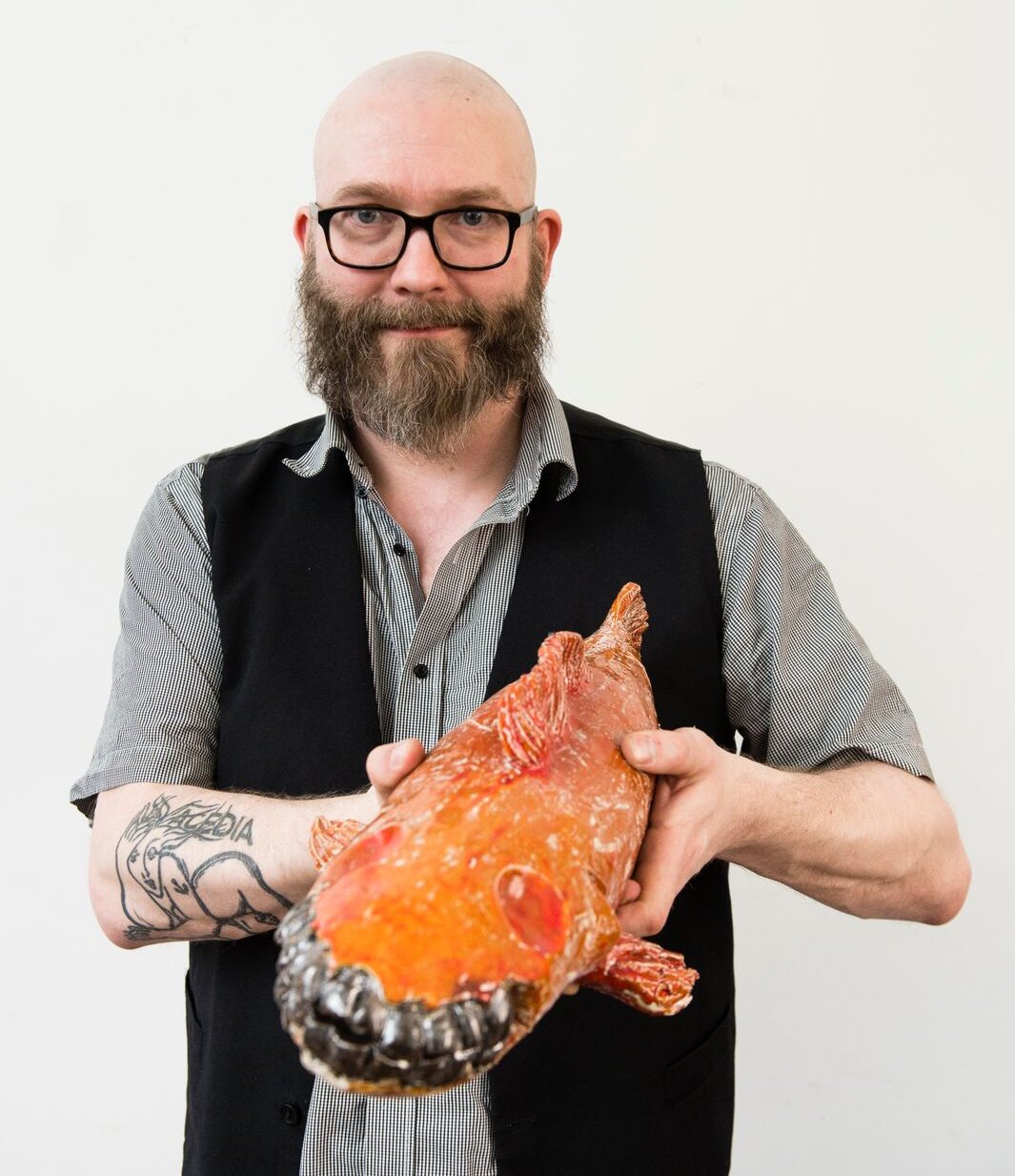
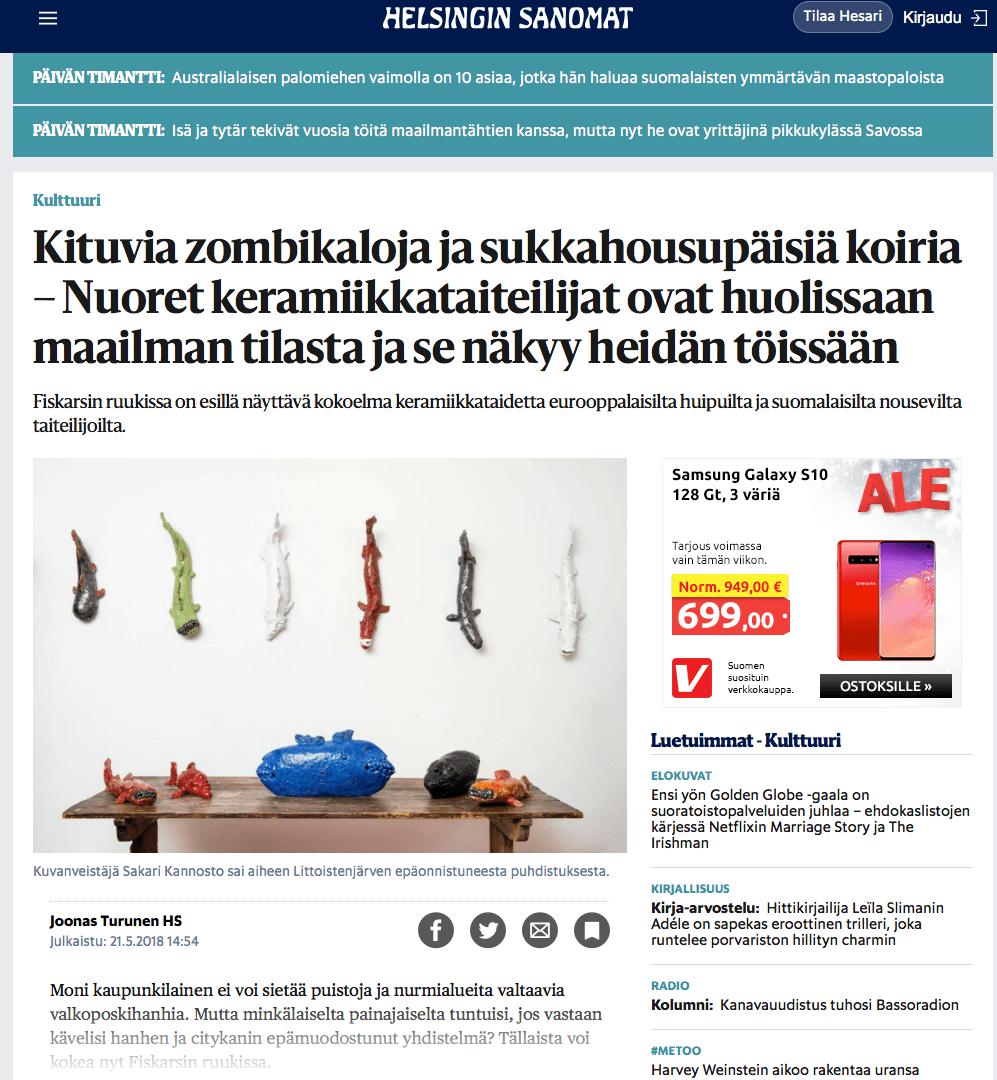
https://ceramicartsnetwork.org/ceramics-monthly/ceramics-monthly-article/spotlight-changing-times#
Ceramics Monthly: How does your sculptural work combine folktales, myths, and other stories with your concerns for the environment and observations about changing times as well as everyday life?
Sakari Kannosto: To me, stoneware is a paramount material and medium. Since the beginning of time, people have marked and molded the most important information on clay. According to ancient traditions, clay has functioned as the carrier of wishes and dreams for fertility, harvest, and prey. Ceramics is also a tool for creativity, play, humor, and storytelling. I am interested in clay as a conveyor of strong narrative expression and as a performer of provocative forms. I investigate the possibilities of clay acting as a light- and gravity-challenging medium of expression, instead of its traditional nature as a heavy, earthy material. Combining clay with other materials, such as glass and steel, has potential in bringing out new, airy dimensions in its use.
I use the coiling technique to build works of all sizes. They are influenced by art history, folk tales, and popular culture. I often combine elements from my everyday life into my art. I strive for a clear and representational language of form that still maintains expressiveness and improvisation with a rugged appearance. I move in a wide range of subjects in my works, and I try to find something new and significant for myself with every new topic. I hope that my works and hand print will still remain recognizable through different exhibitions and changes in subject matter, methods, glazes, and materials.
I often let intuition guide my work. I just start molding and let my feeling and the clay lead the way. Sometimes the most imaginative relationships, shapes, and entities emerge that I couldn’t have seen at the beginning.
Environmental themes and our challenge as humanity to find sustainable development in our everyday life have been significant elements of my storytelling recently. I want to combine several different levels of meaning with my sculptures, and I strive to find a new kind of narrative created in the field of ceramic art. In Finnish and Scandinavian mythology, the spirits of seas, lakes, and nature have always had an important part and place. When working on the “Children of the Flood” exhibition, I wanted to combine parts of various myths: the sinking of ancient civilizations and birth theories. In my story, nature and man come together in a maritime play. It’s kind of a reverse evolution, with a hope to find harmony in a new, difficult situation. The narrators in the exhibition are imaginative hybrids between humans and sea animals. They act also as messengers and intermediaries between different worlds.
At the moment, the declining faith in science has created a wave of fake news. Belief in rumors, predictions, and conspiracy theories surpasses proven facts. In the exhibition, oracles, seers, soothsayers, and clairvoyants appear, symbolizing the faith in fate, lottery, and omens on the edge of the inevitable. Who do we ask for advice when the worst has already happened and there is no direction left?
References to museums, artifacts, and collections of ancient cultures can also be seen in the exhibition. This body of work mainly consists of figures glazed in white and highlighted with platinum. Colorlessness clarifies the subject matter and creates space for imagination and the language of form.
My figurative works also criticize patriarchal assumptions and predictable gender roles—what a mermaid or a water creature should look like. There have always been sensitive yet strong, multidimensional people in my life and family, and they have influenced my figures. My works do not necessarily have traditional gender roles although there are descendants and parents.
The faces of my figures often have a symbolic diving helmet or their eyes are covered as if by glasses or mirroring surfaces. I use this to describe speed blindness and a narrow field of vision in a situation where, as humanity, we would need more clarity, equality, broad visions of the future, and self reflection.
Ceramics is a way to ask questions and to grow. It also helps me grow as a person, as an artist, and as a visual-arts educator.
Photo: Chikako Harada.
Dystopia of a deluge Sakari Kannosto, At the Last Shore (The Beach) Mältinranta Art Center, Tampere, 6-29 January Art Magazine TAIDE.
Text: Maaria Salo
Dystopia of a deluge
Sakari Kannosto, At the Last Shore (The Beach)
Mältinranta Art Center, Tampere, 6-29 January
Text: Maaria Salo
When a sculptor makes an exhibition, the use of space can itself be like a work of its own. One makes an observation quite like this in Sakari Kannosto’s (1973) solo exhibition in Mältinranta. The works placed in the space fill the volume as maximum heights, rhythmically placed in a clear but yielding dialogue, forming a cohesive yet diverse entity.
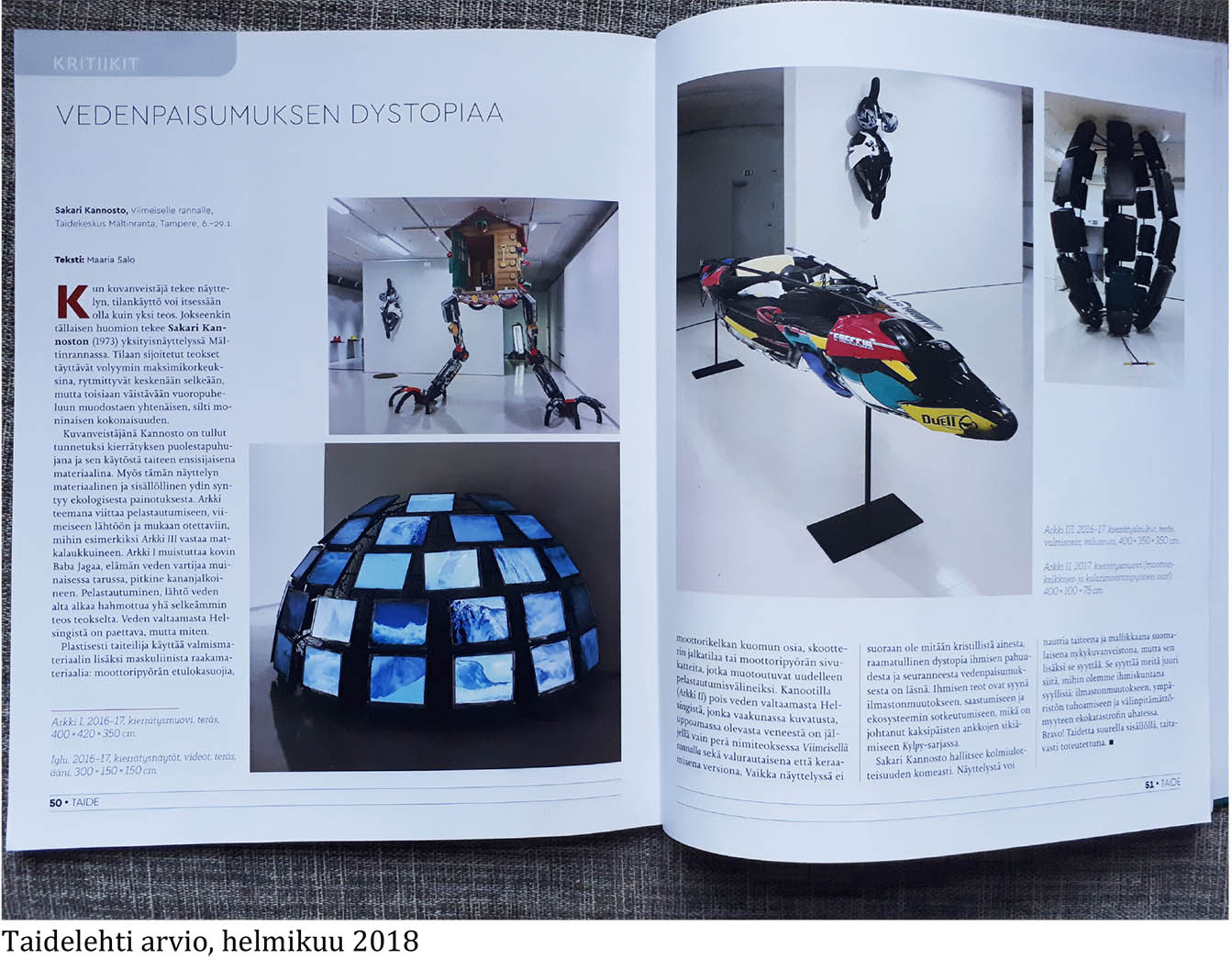
As a sculptor, Kannosto has become known as an advocate of recycling and its use as a primary material for art. Also the core of this exhibition, in material and content, originates in an ecological emphasis. Ark as a theme refers to survival, the last departure and what is brought along, to which for example Ark III responds with its suitcases. Ark I is highly reminiscent of Baba Jaga, the guardian of the water of life in an ancient fable, with its long chicken legs. Survival, the departure from under the water starts to become clearer work by work. One must escape Helsinki taken over by water, but how.
In addition to the ready-made material, the artist plastically uses masculine raw material: motorcycle front fenders, snowmobile canopy parts, scooter footwells or motorcycle side covers, which are transformed into survival tools. Canoeing (Ark II) away from the water-covered Helsinki, whose coat of arms with the sinking boat is pictured in the titular piece At the Last Shore, with only the stern showing, in both cast iron and ceramic. Although there is no directly Christian material in the exhibition, the biblical dystopia of human evil and the ensuing deluge is present. Human deeds are the cause of climate change, pollution, and degradation of the ecosystem, which has led to the breeding of the two-headed ducks in the Bath series.
Sakari Kannosto gracefully manages the three-dimensionality. The exhibition can be enjoyed as art and as exemplary Finnish contemporary sculpture, but it also accuses. It accuses us of exactly what we as humankind are guilty of: climate change, environmental destruction and indifference in the face of an ecological catastrophe.
Bravo! Art with great content, skilfully executed.
Photo captions:
Ark I, 2016-17, recycled plastic, steel, 400 x 420 x 350cm
Igloo, 2016-17, recycled screens, videos, steel, sound, 300 x 150 x 150cm
Ark III, 2016-17, recycled suitcases, ready-made steel parts, cast iron, 400 x 350 x 350cm
Ark II, 2017, recycled plastic (snow mobile and crashed motorbikes’ parts), 400 x 100 x 75cm
Vedenpaisumuksen dystopiaa
Sakari Kannosto, Viimeisellä rannalla
Taidekeskus Mältinranta, Tampere, 6.-29.1.
Teksti: Maaria Salo
Kun kuvanveistäjä tekee näyttelyn, tilankäyttö voi itsessään olla kuin yksi teos. Jokseenkin tällaisen huomion tekee Sakari Kannoston (1973) yksityisnäyttelyssä Mältinrannassa. Tilaan sijoitetut teokset täyttävät volyymin maksimikorkeuksina, rytmittyvät keskenään selkeään, mutta toisiaan väistävään vuoropuheluun muodostaen yhtenäisen, silti moninaisen kokonaisuuden.
Kuvanveistäjänä Kannosto on tullut tunnetuksi kierrätyksen puolestapuhujana ja sen käytöstä taiteen ensisijaisena materiaalina. Myös tämän näyttelyn materiaalinen ja sisällöllinen ydin syntyy ekologisesta painotuksesta. Arkki teemana viittaa pelastautumiseen, viimeiseen lähtöön ja mukaan otettaviin, mihin esimerkiksi Arkki IIIvastaa matkalaukkuineen. Arkki I muistuttaa kovin Baba Jagaa, elämän veden vartijaa muinaisessa tarussa, pitkine kananjalkoineen. Pelastautuminen, lähtö veden alta alkaa hahmottua yhä selkeämmin teos teokselta. Veden valtaamasta Helsingistä on paettava, mutta miten.
Plastisesti taiteilija käyttää valmismateriaalin lisäksi maskuliinista raakamateriaalia: moottoripyörän etulokasuojia, moottorikelkan kuomun osia, skootterin jalkatilaa tai moottoripyörän sivukatteita, jotka muotoutuvat uudelleen pelastautumisvälineiksi. Kanootilla (Arkki II) pois veden valtaamasta Helsingistä, jonka vaakunassa kuvatusta, uppoamassa olevasta veneestä on jäljellä vain perä nimiteoksessa Viimeisellä rannalla sekä valurautaisena että keraamisena versiona. Vaikka näyttelyssä ei suoraan ole mitään kristillistä ainesta, raamatullinen dystopia ihmisen pahuudesta ja seuranneesta vedenpaisumuksesta on läsnä. Ihmisen teot ovat syynä ilmastonmuutokseen, saastumiseen ja ekosysteemin sotkeutumiseen, mikä on johtanut kaksipäisten ankkojen sikiämiseen Kylpy-sarjassa.
Sakari Kannosto hallitsee kolmiulotteisuuden komeasti. Näyttelystä voi nauttia taiteena ja mallikkaana suomalaisena nykykuvanveistona, mutta sen lisäksi se syyttää. Se syyttää meitä juuri siitä, mihin olemme ihmiskuntana syyllisiä: ilmastonmuutokseen, ympäristön tuhoamiseen ja välinpitämättömyyteen ekokatastrofin uhatessa.
Bravo! Taidetta suurella sisällöllä, taitavasti toteutettuna.
Kuvatekstit:
Arkki I, 2016-17, kierrätysmuovi, teräs, 400 x 420 x 350cm
Iglu, 2016-17, kierrätysnäytöt, videot, teräs, ääni, 300 x 150 x 150cm
Arkki III, 2016-17, kierrätyslaukut, teräs-valmisosat, valurauta, 400 x 350 x 350cm
Arkki II, 2017, kierrätysmuovi (moottorikelkkojen ja kolarimoottoripyörien osat), 400 x 100 x 75cm
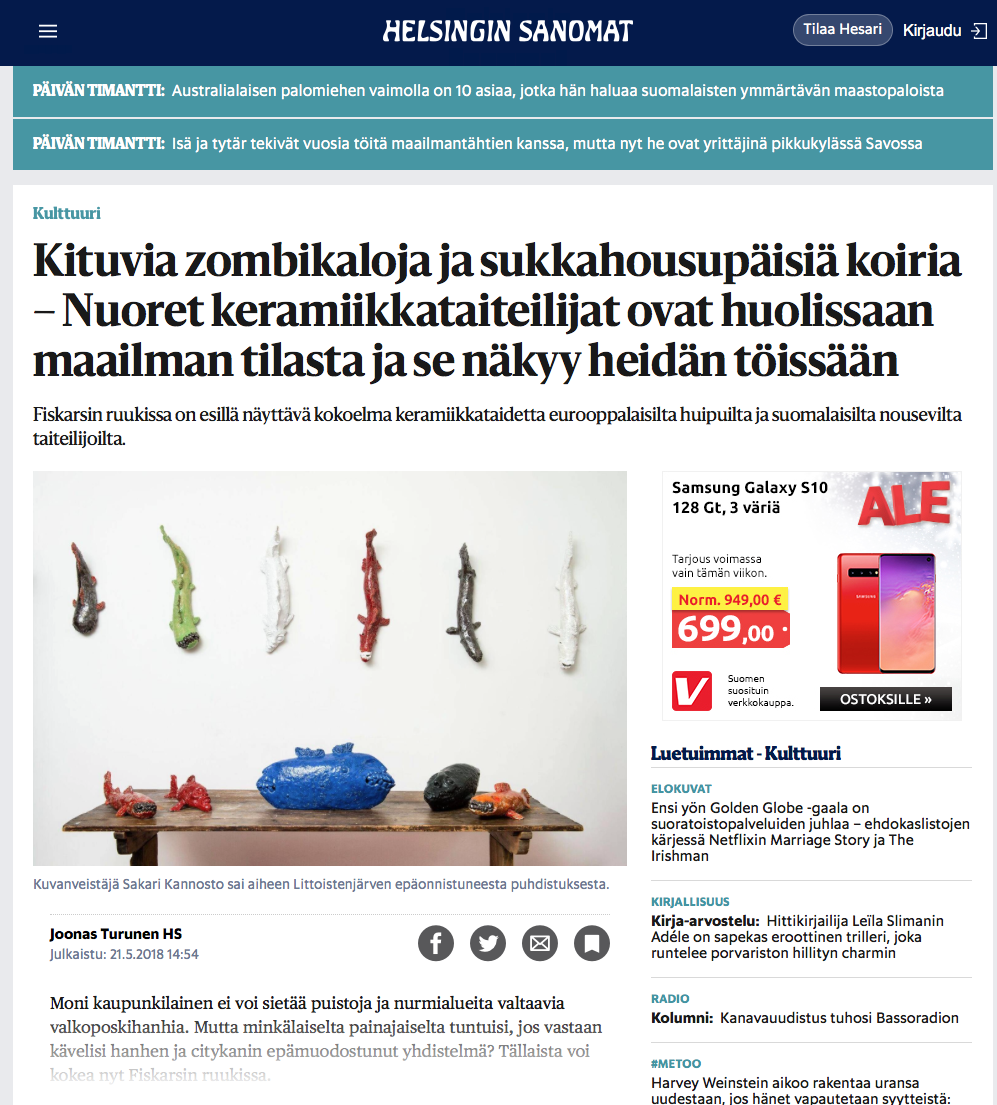
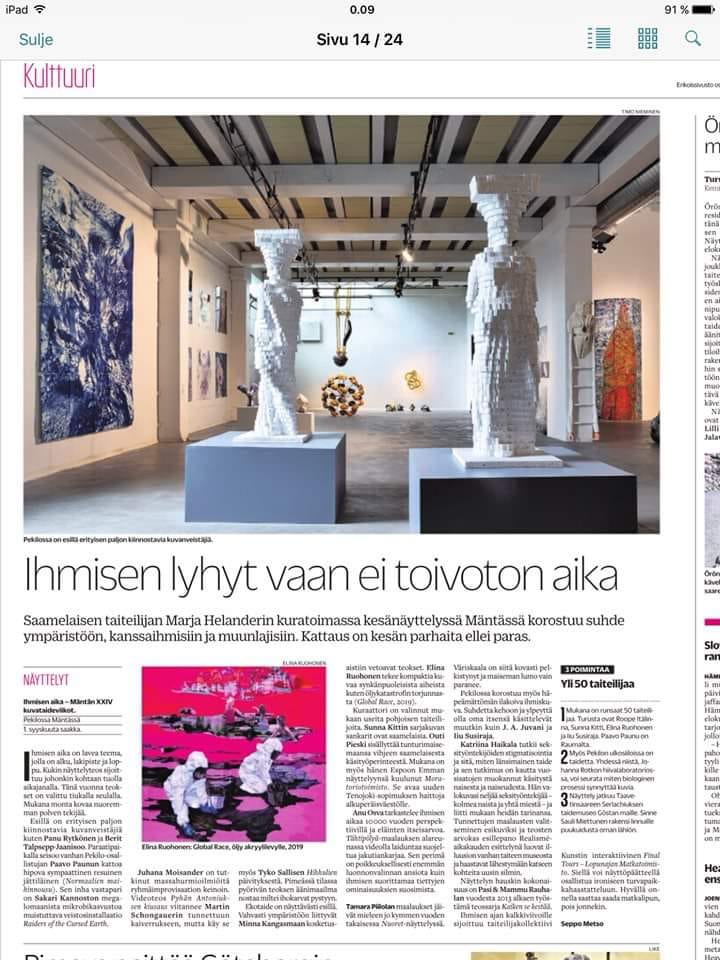
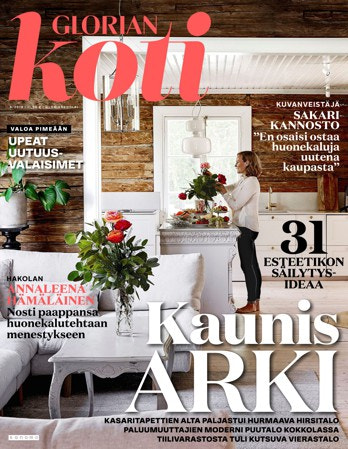


 Sakari Kannosto